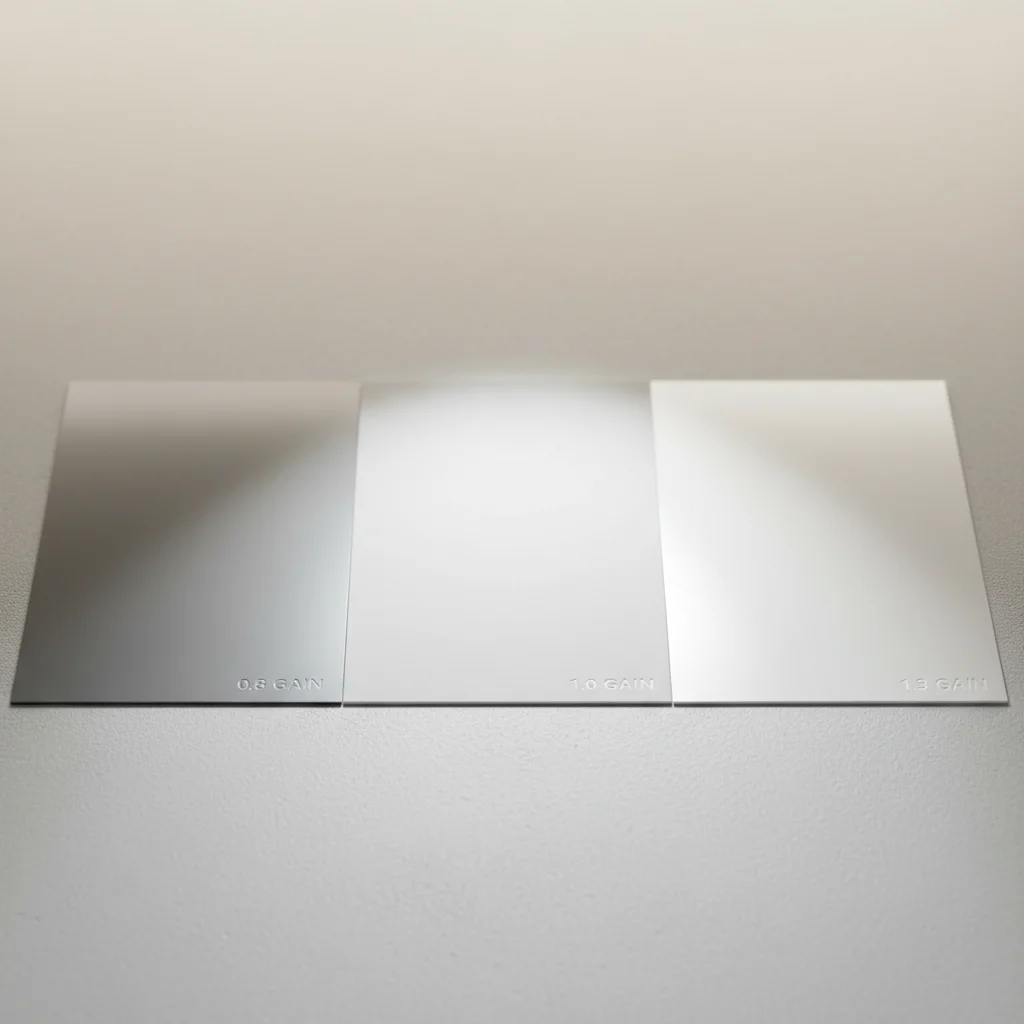
Projector screen gain refers to a screen’s ability to reflect light back to the viewer, and it’s a crucial factor in determining image brightness and viewing angles. A screen with a gain of 1.0 is considered neutral, reflecting all projected light equally in all directions. Higher gain screens (e.g., 1.5 or 2.0) amplify brightness but often narrow the optimal viewing cone, while lower gain screens (e.g., 0.8) offer wider viewing angles at the cost of some brightness. Understanding gain helps you choose the right screen for your specific room conditions and projector.
Understanding Gain Values and Their Impact
Gain values are a numerical representation of a screen’s reflectivity. A gain of 1.0 serves as the baseline, meaning the screen reflects light with the same intensity as a standard white matte surface. Screens with a gain greater than 1.0, such as 1.1 or 1.3, are designed to reflect more light towards the center of the viewing area, making the image appear brighter. This can be particularly beneficial in rooms with some ambient light or when using a lower-lumen projector. Conversely, screens with a gain less than 1.0, like 0.8, diffuse light more broadly, resulting in a wider viewing angle but a slightly dimmer image. These are often preferred in dedicated home theaters where light control is excellent and a consistent image across a large audience is desired.
High Gain Screens: Brightness vs. Viewing Angle
High gain screens, typically with values ranging from 1.3 to 2.5, are engineered to maximize brightness. They achieve this by concentrating the reflected light into a narrower cone. This means that viewers seated directly in front of the screen will experience a significantly brighter and more vibrant image. However, as viewers move off-axis, the image brightness can drop noticeably, and color shifts may become apparent. This phenomenon is known as ‘hot-spotting’ and is a common characteristic of very high gain screens. They are best suited for environments where viewers are primarily positioned within a relatively narrow central viewing area, such as a small home theater or a conference room with fixed seating.
Low Gain Screens: Wide Angles and Color Accuracy
|
Our Picks for the Best Projector Screen in 2026
As an Amazon Associate I earn from qualifying purchases.
|
||
| Num | Product | Action |
|---|---|---|
| 1 | Outdoor Projector Screen with Stand - 120 Inch Portable Projector Screen Indoor and Outdoor Projector Screens 16:9 4K HD Wrinkle Free Lightweight Movie Screen with Carry Bag,Enioy Movie Nights |

|
| 2 | Taotique Projector Screen 72 inch, Movie Projector Screen 16:9 HD Foldable and Portable Anti-Crease Indoor Outdoor Projection Double Sided Video Projector Screen for Home, Party, Office, Classroom |
|
| 3 | AAJK Projector Screen 150 inch, Washable Projector Screen 16:9 Foldable Anti-Crease Portable Projector Movies Screen for Home Theater Outdoor Indoor Support Double Sided Projection |
|
| 4 | Projector Screen,HUANYINGBJB 4K 16:9 HD Rear Front Projector Screen Foldable Projection Screen Double-Sided Portable Outdoor Indoor Projector Screens for Movie Home Theater (120) |
|
| 5 | Pyle 50 Inch Portable Projector Screen with Tripod Stand – Lightweight, Durable, Easy Pull Setup Mobile Projection Screen with 4:3 Aspect Ratio, White Matte Fabric for Indoor/Outdoor Use |
|
| 6 | TOWOND Projector Screen and Stand, 150 inch Indoor Outdoor Projection Screen, Portable 16:9 4K HD Rear Front Movie Screen with Carry Bag Wrinkle-Free Design for Home Theater Backyard Cinema |
|
| 7 | 120inch Outdoor Projector Screen with Stand: 16:9 4K HD Portable Projector Screen Outdoor Indoor - Front/Rear Movie Screen with Carry Bag, Sandbag - Projection Screen for Backyard, Camping, Theater |
|
| 8 | TOWOND Outdoor Projector Screen with stand, 120 inch Portable Movie Screen - 16:9 4K HD Foldable Anti-Crease Projection Screen with Carry Bag for Movie Nights, Camping and Parties Support Double Sided |
|
| 9 | 120 inch Projector Screen 2025 Upgraded- Black Backing, Straight Edges, Foldable, Washable and Wrinkle-Free - for Indoor Home Theater and Outdoor Cinema -White 16:9 by IOLIEO |
|
| 10 | TOWOND Projector Screen with Stand, 100 inch Outdoor Projector Screen Portable Indoor Projection Screen 16:9 4K Rear Front Movie Screen with Carry Bag for Home Backyard Theater 100 inch |
|
Low gain screens, with values typically between 0.7 and 0.9, prioritize a wide viewing angle and excellent color uniformity. Instead of concentrating light, these screens are designed to diffuse it more evenly across a broader area. This ensures that everyone in the room, regardless of their seating position, experiences a consistent image with accurate colors and minimal brightness fall-off. While the overall perceived brightness might be slightly lower compared to high gain screens, the advantage lies in the absence of hot-spotting and a more immersive experience for a larger audience. They are ideal for large living rooms, open-plan spaces, or any setup where viewers will be spread out.
Neutral Gain Screens: The Balanced Choice
Neutral gain screens, with a gain value of 1.0, offer a balanced approach. They reflect light evenly across all viewing angles without amplifying or diminishing the brightness. This results in a natural-looking image with accurate color reproduction and no hot-spotting, making them a versatile choice for a wide range of applications. They are a popular option for dedicated home theaters with good light control, as they allow the projector’s native brightness and color accuracy to shine through without any artificial manipulation from the screen material. For many users, a 1.0 gain screen provides the best compromise between brightness, viewing angle, and color fidelity.
Choosing the Right Gain for Your Setup
Selecting the appropriate screen gain depends on several factors:
- Projector Brightness: A lower lumen projector might benefit from a higher gain screen to boost perceived brightness.
- Room Ambient Light: Rooms with some ambient light often benefit from higher gain screens to combat washout.
- Viewing Angles: If you have a wide seating arrangement, a lower gain screen will provide a more consistent image for everyone.
- Screen Size: Larger screens often require more light, so a higher gain can help maintain brightness.
- Personal Preference: Some viewers prefer the punchier image of a high gain screen, while others prioritize uniform brightness and color.
Consider these points carefully to ensure your projector screen complements your projector and viewing environment perfectly.
Advanced Screen Technologies and Gain
Beyond standard matte white screens, advanced technologies like Ambient Light Rejecting (ALR) screens also incorporate gain characteristics. ALR screens are specifically designed to reject off-axis light (ambient light) while reflecting light from the projector (on-axis light) back to the viewer. Their gain values can vary, and they are often optimized for specific projector types (e.g., ultra-short throw). While they effectively combat ambient light, it’s still important to consider their gain and viewing angle specifications, as some ALR screens can also exhibit hot-spotting if the gain is too high for the viewing environment. Always check the manufacturer’s recommendations for optimal performance.
Get our weekly buyer guide
Practical specs, not advice. Unsubscribe anytime.
