High contrast Ambient Light Rejecting (ALR) projector screens significantly enhance home theater experiences by delivering deep blacks, vibrant colors, and sharp details even in well-lit rooms. These screens achieve this by intelligently deflecting ambient light from sources like windows or overhead fixtures while focusing the projector’s output directly to the viewer. This guide explores various ALR screen types, essential features, and selection criteria to optimize your home cinema viewing pleasure.
Common Types of Projector Screens
Understanding projector screen types is crucial, as ALR technology integrates into several designs, each offering distinct advantages based on your space and preferences. While traditional matte white screens scatter light uniformly, ALR screens employ specialized optical layers to manage light direction, which is critical for achieving high contrast in any room. Identifying the form factor that best suits your home is the first step toward a superior viewing experience.
Fixed Frame Projector Screens
Fixed frame screens are designed for permanent installation, similar to a large, wall-mounted television. These screens offer exceptional flatness because the material is constantly tensioned over a rigid frame, eliminating wrinkles or waves that could distort the image. Their robust construction ensures long-term durability and a consistently pristine viewing surface. Ideal for dedicated home theaters or media rooms, fixed frame ALR screens provide a premium, immersive aesthetic that seamlessly integrates into your décor, always ready for action.
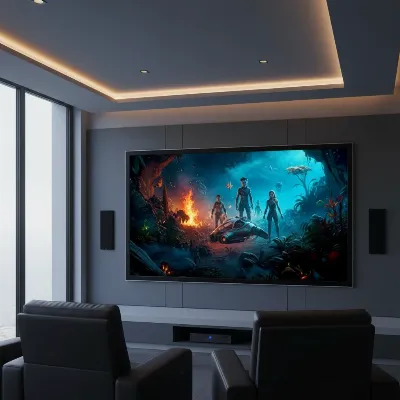 A modern fixed-frame high contrast ALR projector screen mounted in a dedicated home theater room with some ambient light, showcasing a vivid image.
Motorized Drop-Down Projector Screens
For those who desire a large projection display but prefer it to be out of sight when not in use, motorized drop-down screens are an excellent choice. These screens are typically installed in the ceiling or on a wall and retract silently at the touch of a button, preserving the room’s aesthetics. Many high-quality motorized ALR screens feature tab-tensioning systems that keep the screen surface perfectly flat, preventing the curling or wrinkling often associated with non-tensioned retractable screens. They are ideal for multi-purpose living rooms or conference spaces where versatility and elegance are paramount.
Floor-Rising Projector Screens
Floor-rising screens offer a sophisticated and often luxurious solution, emerging from a hidden console on the floor. This type of screen is particularly well-suited for minimalist designs or spaces where wall or ceiling installation is not feasible or desired. Like their motorized drop-down counterparts, high-end floor-rising ALR screens can be tab-tensioned to maintain a perfectly flat surface, crucial for sharp, undistorted images, especially with ultra-short throw projectors. They represent a premium choice for smart homes, offering unparalleled convenience and a sleek, integrated look.
Portable Projector Screens
|
Our Picks for the Best Projector Screen in 2026
As an Amazon Associate I earn from qualifying purchases.
|
||
| Num | Product | Action |
|---|---|---|
| 1 | Outdoor Projector Screen with Stand - 120 Inch Portable Projector Screen Indoor and Outdoor Projector Screens 16:9 4K HD Wrinkle Free Lightweight Movie Screen with Carry Bag,Enioy Movie Nights |

|
| 2 | Taotique Projector Screen 72 inch, Movie Projector Screen 16:9 HD Foldable and Portable Anti-Crease Indoor Outdoor Projection Double Sided Video Projector Screen for Home, Party, Office, Classroom |
|
| 3 | 120inch Outdoor Projector Screen with Stand: 16:9 4K HD Portable Projector Screen Outdoor Indoor - Front/Rear Movie Screen with Carry Bag, Sandbag - Projection Screen for Backyard, Camping, Theater |
|
| 4 | TOWOND Outdoor Projector Screen with stand, 120 inch Portable Movie Screen - 16:9 4K HD Foldable Anti-Crease Projection Screen with Carry Bag for Movie Nights, Camping and Parties Support Double Sided |
|
| 5 | TOWOND Projector Screen and Stand, 150 inch Indoor Outdoor Projection Screen, Portable 16:9 4K HD Rear Front Movie Screen with Carry Bag Wrinkle-Free Design for Home Theater Backyard Cinema |
|
| 6 | Pyle 50 Inch Portable Projector Screen with Tripod Stand – Lightweight, Durable, Easy Pull Setup Mobile Projection Screen with 4:3 Aspect Ratio, White Matte Fabric for Indoor/Outdoor Use |
|
| 7 | TOWOND Projector Screen with Stand, 100 inch Outdoor Projector Screen Portable Indoor Projection Screen 16:9 4K Rear Front Movie Screen with Carry Bag for Home Backyard Theater 100 inch |
|
| 8 | Projector Screen,HUANYINGBJB 4K 16:9 HD Rear Front Projector Screen Foldable Projection Screen Double-Sided Portable Outdoor Indoor Projector Screens for Movie Home Theater (120) |
|
| 9 | AAJK Projector Screen 150 inch, Washable Projector Screen 16:9 Foldable Anti-Crease Portable Projector Movies Screen for Home Theater Outdoor Indoor Support Double Sided Projection |
|
| 10 | 120 inch Projector Screen 2025 Upgraded- Black Backing, Straight Edges, Foldable, Washable and Wrinkle-Free - for Indoor Home Theater and Outdoor Cinema -White 16:9 by IOLIEO |
|
While fixed and motorized ALR screens are ideal for permanent installations, portable projector screens cater to flexibility and on-the-go entertainment. These screens, often featuring lightweight frames or tripod stands, are designed for quick setup and takedown, making them perfect for outdoor movie nights, impromptu presentations, or temporary event setups. Although not all portable screens feature advanced ALR technology, some modern options incorporate ambient light rejecting materials, allowing for a noticeable improvement in image quality even in less-than-ideal lighting conditions. Their primary advantage lies in their unmatched mobility, transforming any location into a viewing space.
Comparing Projector Screen Types
Choosing the right projector screen involves weighing various factors, from initial cost to long-term performance and ease of use. High contrast ALR technology is a significant investment that enhances any setup, but its integration varies across different screen types. The following comparison highlights key differences to help you determine which projector screen best fits your specific needs and environment, ensuring you make an informed decision for your home cinema.
Detailed Comparison Table
The nuances between screen types, especially when incorporating ALR, can greatly impact your viewing experience. This table provides a clear overview, comparing essential criteria to guide your selection.
| Feature | Fixed Frame ALR Screen | Motorized Drop-Down ALR Screen | Floor-Rising ALR Screen | Portable ALR Screen | Matte White Screen (Baseline) |
|---|---|---|---|---|---|
| Price Range | High | High to Very High | Very High | Moderate to High | Low to Moderate |
| Material Quality | Premium, tensioned | Premium, often tab-tensioned | Premium, often tab-tensioned | Good to Premium | Basic fabric/vinyl |
| Sizes Available | Large (100-200+” diagonal) | Medium to Large (80-150+” diagonal) | Medium to Large (80-150+” diagonal) | Small to Medium (60-120+” diagonal) | Small to Very Large (60-300+” diagonal) |
| Contrast Enhancement | Excellent, deep blacks in ambient light | Excellent, deep blacks in ambient light | Excellent, deep blacks in ambient light | Good to Excellent | Poor in ambient light |
| Ambient Light Rejection | Very High (80-95%+) | Very High (80-95%+) | Very High (80-95%+) | Moderate to High (60-85%+) | Very Low (10-20%) |
| Portability | None (Permanent) | Low (Retractable, but installed) | Low (Retractable, but installed) | Very High (Easy setup/takedown) | Low (Often installed, or basic tripod) |
| Installation | Wall-mounted, permanent | Ceiling/wall-mounted, professional recommended | Floor-mounted console, professional recommended | Quick assembly, freestanding | Wall-mounted or freestanding |
| Best Use Case | Dedicated home theaters, media rooms | Multi-purpose living rooms, conference spaces | Modern minimalist homes, open-plan living | Outdoor, temporary setups, presentations | Dark, controlled lighting environments |
ALR screens, regardless of their form factor, provide a significant leap in performance compared to traditional matte white screens, especially in rooms with uncontrolled lighting. They address the common issue of washed-out images, delivering a brighter and more vivid picture by selectively reflecting projector light while minimizing ambient interference. This technological advantage makes ALR screens a superior choice for anyone seeking a truly immersive viewing experience outside of a completely darkened room.
Key Factors When Choosing a Projector Screen (Buying Guide)
Selecting the ideal high contrast ALR projector screen involves a meticulous evaluation of several critical factors. Beyond merely choosing a type, understanding the technical specifications and how they interact with your projector and viewing environment is paramount. Investing in the right screen means optimizing your image quality, ensuring vibrant colors, sharp details, and impressive contrast, even with the lights on.
Screen Size and Aspect Ratio
The size of your projector screen should be determined by your room dimensions and viewing distance to ensure a comfortable and immersive experience. A good rule of thumb is to divide your primary viewing distance (in inches) by 1.5 to estimate the ideal screen width, ensuring all viewers can comfortably see the entire image without excessive head movement. Most home theater content, including movies, TV shows, and gaming, is best displayed on a 16:9 aspect ratio screen, which has become the industry standard. For cinematic purists, a 2.35:1 (CinemaScope) aspect ratio might be preferred for ultra-widescreen films, though this typically means black bars will appear on the sides for 16:9 content.
Screen Material and ALR Technology
The heart of an ALR screen lies in its specialized material, engineered to manipulate light. Unlike standard matte white screens, which scatter light in all directions and result in washed-out images in bright rooms, ALR screens use optical coatings or micro-layered surfaces. These surfaces are designed to reflect the projector’s light directly back to the viewer while simultaneously deflecting or absorbing stray ambient light from windows, lamps, or ceiling fixtures.
There are primarily two types of ALR technology:
- Angular/Specular Reflective screens reflect light at an equal angle to its origin. These are often used with standard (long-throw) projectors.
- Micro-optical/Lenticular/Fresnel screens utilize intricate microstructures. These are specifically engineered for Ultra Short Throw (UST) projectors, accepting light from below at a steep angle while aggressively blocking overhead ambient light. CLR (Ceiling Light Rejecting) screens are a specialized subset of micro-optical ALR designed primarily for UST projectors to reject light coming from directly above. Choosing the correct ALR type based on your projector’s throw ratio is crucial; mismatching can lead to a dim or distorted image.
Gain Value
Screen gain measures how much light a screen reflects back to the viewer compared to a standard white reference surface (which has a gain of 1.0). While traditional ALR screens might have a gain ranging from 1.2 to 2.5+, concentrating light for increased perceived brightness, higher gain can narrow the viewing angle and potentially introduce “hot-spotting,” where the center appears noticeably brighter. For UST ALR screens, a gain between 0.5 and 1.0 is often recommended, balancing brightness with wide viewing angles and natural color reproduction. Modern projectors are generally bright enough that excessively high gain is rarely necessary, and a lower gain can often improve overall image uniformity and color accuracy.
Contrast and Brightness Enhancement
The primary appeal of high contrast ALR screens is their remarkable ability to preserve and enhance image quality, even in environments with significant ambient light. By rejecting stray light, these screens significantly deepen black levels, preventing them from appearing as murky grey. This improved black floor, combined with the efficient reflection of projector light, leads to a dramatic increase in perceived contrast and color saturation. Compared to a standard matte white screen, a good ALR screen can deliver up to a 100-fold increase in contrast, making colors more vibrant and details sharper, transforming a dull, washed-out image into a captivating visual experience that rivals a high-end television.
Viewing Angle
The viewing angle refers to the range from which an audience can comfortably view the projected image without experiencing a significant drop in brightness or color shift. For a truly inclusive home theater, a wide viewing angle is essential, ideally 120 degrees or more, ensuring that viewers seated off-center still enjoy a consistent, high-quality picture. While high-gain screens can sometimes narrow this angle, well-designed ALR screens are engineered to maintain impressive uniformity across a broad viewing cone. This is particularly important for living room setups where seating positions are often more varied than in a dedicated, perfectly aligned theater.
Ambient Light Rejection Capability
The effectiveness of an ALR screen is directly tied to its ambient light rejection capabilities, which are measured by the percentage of unwanted light it can block. High-quality ALR screens can reject between 80% to 95% or more of ambient light from sources like windows or ceiling lights. This crucial feature means you no longer need a completely darkened room to enjoy your projector. For UST projectors, specialized CLR screens are adept at rejecting light specifically from overhead, ensuring the light from your projector, positioned below, is effectively reflected. This technological prowess allows for vibrant, high-contrast images day or night, fundamentally changing how and where you can use your projector.
Brand and Price
The market for high contrast ALR projector screens features several reputable brands known for their innovation and quality. Elite Screens, Spectra Projection, Screen Innovations (SI), WEMAX, and SCREEN PRO are among the leaders, offering a range of ALR solutions across different types and price points. While ALR screens are generally a more significant investment than conventional screens due to their complex optical layers, the enhanced viewing experience they provide justifies the cost for many enthusiasts. Prices vary widely based on size, screen type (fixed, motorized, floor-rising), material technology, and gain. Roll-up ALR screens tend to be more budget-friendly than motorized or fixed-frame options, but investing in a quality screen from a recognized brand often ensures better performance, durability, and a robust warranty.
“The screen is not just a canvas; it’s a finely tuned optical instrument that unlocks the full potential of your projector. For a truly immersive experience in any room, a high-contrast ALR screen is the critical component that bridges the gap between good and extraordinary.” – ReviewsBazzar.com Admin, Projector Screen Technician with 10+ years of experience.
Conclusion
Choosing the best high contrast ALR projector screen is about more than just finding a surface to project onto; it’s about crafting an immersive visual experience that defies typical room lighting limitations. By understanding the different screen types—fixed frame, motorized drop-down, and floor-rising—and key factors like material technology, gain, viewing angle, and ambient light rejection, you can make an informed decision tailored to your specific needs. An ALR screen is a pivotal component that maximizes your projector’s performance, delivering unparalleled contrast, vibrant colors, and sharp details, even in brightly lit environments.
Invest in the right ALR screen, and you’ll unlock a new dimension of home entertainment, transforming your living space into a flexible, high-performance cinema. Which ALR screen will improve your home cinema experience to cinematic perfection?
Frequently Asked Questions
Get our weekly buyer guide
Practical specs, not advice. Unsubscribe anytime.

The high contrast ALR screen definitely makes a difference for deep blacks and vibrant colors, which is great. My only minor complaint is that the viewing angle isn’t quite as wide as I’d hoped. If you’re not sitting directly in front, there’s a slight drop in brightness. Still, for the main viewing spots, it’s fantastic.
This guide helped me understand the different ALR screen types. I went with a fixed frame option for my dedicated home cinema, and the sharp details are incredible. It really does focus the projector’s output directly to the viewer, making everything pop. My old matte white screen just can’t compare.
I was skeptical about how much an ALR screen could really improve things in a well-lit room, but wow. The way it deflects ambient light is genius. We use ours for outdoor movie nights too, and even with some lingering daylight, the image quality is surprisingly good. Definitely worth the investment for anyone serious about their home theater.
I finally upgraded to an ALR screen after reading about them, and the difference is night and day! My living room has a huge window, and before, watching anything during the day was impossible. Now, with the specialized optical layers, the picture is so clear and vibrant, even with some ambient light. It’s truly transformed our family movie nights.