Imagine transforming your campsite into an open-air cinema, screening your favorite movies or sharing unforgettable photos under a canopy of stars. With the rapid advancements in portable technology, this dream is more accessible than ever. Choosing the right portable projector screen for your camping adventures, however, can be tricky. You need a screen that is not only compact and easy to set up but also durable enough to withstand the unpredictable elements of the great outdoors. This comprehensive guide will help you navigate the options, highlighting the top choices for 2026, and ensure you make an informed decision for your next outdoor movie night.
Types of Portable Projector Screens for Camping
When it comes to bringing big-screen entertainment to your camping trip, several types of portable projector screens stand out, each offering unique advantages for different outdoor scenarios. Understanding these variations is key to selecting the perfect companion for your portable projector.
Foldable Frame Screens
Foldable frame screens are a popular choice for campers who prioritize a flat, taut viewing surface and relative stability. These screens typically feature a lightweight aluminum frame that snaps together, with the screen material attaching securely via clips or elastic grommets. Their design ensures a consistently smooth projection surface, which is crucial for optimal image quality outdoors. Many models, such as the Elite Screens Yard Master 2, are designed for quick, tool-free assembly, often taking only minutes to set up.
- Pros: Provide a very flat and wrinkle-free surface for superior image quality, stable in moderate wind conditions (especially when anchored), and offer a professional aesthetic. They are often tensioned to ensure flatness.
- Cons: Can be slightly heavier and bulkier than other portable options when packed, and may require a flat or leveled surface for optimal setup. Assembly involves more steps compared to inflatable screens.
- Suitable Sizes and Aspect Ratios: Commonly available in 80-inch to 135-inch diagonal sizes, with 16:9 being the standard aspect ratio for widescreen movies. Larger sizes like 100-inch to 120-inch are popular for group viewing.
- Setup and Maintenance: Setup typically involves unfolding the frame, attaching the screen material, and securing the legs or stand. Many include stakes or water bags for added stability against wind. Maintenance usually requires wiping the screen clean with a damp cloth and ensuring it’s fully dry before packing to prevent mildew.
|
Our Picks for the Best Projector Screen in 2026
As an Amazon Associate I earn from qualifying purchases.
|
||
| Num | Product | Action |
|---|---|---|
| 1 | Pyle 50 Inch Portable Projector Screen with Tripod Stand – Lightweight, Durable, Easy Pull Setup Mobile Projection Screen with 4:3 Aspect Ratio, White Matte Fabric for Indoor/Outdoor Use |

|
| 2 | AAJK Projector Screen 150 inch, Washable Projector Screen 16:9 Foldable Anti-Crease Portable Projector Movies Screen for Home Theater Outdoor Indoor Support Double Sided Projection |
|
| 3 | Outdoor Projector Screen with Stand - 120 Inch Portable Projector Screen Indoor and Outdoor Projector Screens 16:9 4K HD Wrinkle Free Lightweight Movie Screen with Carry Bag,Enioy Movie Nights |
|
| 4 | TOWOND Outdoor Projector Screen with stand, 120 inch Portable Movie Screen - 16:9 4K HD Foldable Anti-Crease Projection Screen with Carry Bag for Movie Nights, Camping and Parties Support Double Sided |
|
| 5 | TOWOND Projector Screen and Stand, 150 inch Indoor Outdoor Projection Screen, Portable 16:9 4K HD Rear Front Movie Screen with Carry Bag Wrinkle-Free Design for Home Theater Backyard Cinema |
|
| 6 | 120 inch Projector Screen 2025 Upgraded- Black Backing, Straight Edges, Foldable, Washable and Wrinkle-Free - for Indoor Home Theater and Outdoor Cinema -White 16:9 by IOLIEO |
|
| 7 | TOWOND Projector Screen with Stand, 100 inch Outdoor Projector Screen Portable Indoor Projection Screen 16:9 4K Rear Front Movie Screen with Carry Bag for Home Backyard Theater 100 inch |
|
| 8 | Projector Screen,HUANYINGBJB 4K 16:9 HD Rear Front Projector Screen Foldable Projection Screen Double-Sided Portable Outdoor Indoor Projector Screens for Movie Home Theater (120) |
|
| 9 | Taotique Projector Screen 72 inch, Movie Projector Screen 16:9 HD Foldable and Portable Anti-Crease Indoor Outdoor Projection Double Sided Video Projector Screen for Home, Party, Office, Classroom |
|
| 10 | 120inch Outdoor Projector Screen with Stand: 16:9 4K HD Portable Projector Screen Outdoor Indoor - Front/Rear Movie Screen with Carry Bag, Sandbag - Projection Screen for Backyard, Camping, Theater |
|
Inflatable Projector Screens
For those seeking the largest possible screen size with minimal effort, inflatable projector screens are an excellent option. These screens consist of a durable, weather-resistant material that inflates to create a large frame and projection surface. They are incredibly easy to set up, often requiring just a few minutes with an electric or battery-powered pump. The Vivohome Inflatable Movie Projector Screen is a good example, offering a large seamless viewing area.
- Pros: Offer very large screen sizes, extremely fast setup and takedown, inherently stable due to their air-filled structure and low center of gravity, and lightweight when deflated for transport.
- Cons: Can be vulnerable to punctures from sharp objects, the surface tension may fluctuate slightly with temperature changes, and some models might generate fan noise from the continuous inflation. They also require a power source for the pump.
- Portability and Convenience: When deflated, these screens pack down remarkably small, making them highly portable. Their quick setup makes them ideal for spontaneous outdoor movie nights or larger camping gatherings.
- Applications: Perfect for creating a grand cinematic experience in open spaces like campgrounds, parks, or large backyards. They are particularly favored for events where a “larger-than-life” image is desired without the complexity of a fixed structure.
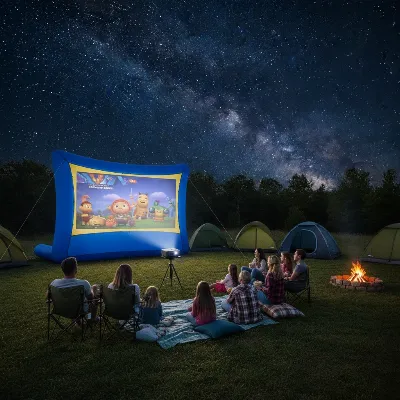 Large inflatable projector screen set up at a camping site under a starry night sky, with people watching a movie
Tripod Projector Screens
Tripod screens are perhaps the most classic form of portable projection, often resembling a large, freestanding easel. They are designed for quick deployment and are generally more compact and lighter than frame screens, making them highly suitable for smaller camping groups or impromptu setups. The VIVO 100″ Portable Projector Screen with Tripod exemplifies this category.
- Pros: Extremely portable and lightweight, very easy and quick to set up and adjust, and generally more affordable than other types. They offer flexibility in placement on uneven terrain due to adjustable legs.
- Cons: The screen material may not be as taut or wrinkle-free as a tensioned frame screen, and they can be less stable in windy conditions compared to frame or inflatable screens. Viewing angles might be narrower depending on the material.
- Mobility and Ease of Use: Their self-standing design means you can set them up almost anywhere you find a flat patch of ground, making them exceptionally convenient for varied camping spots.
- Best for Smaller Gatherings: Ideal for intimate family movie nights, small group presentations, or solo viewing where a compact and easy-to-manage screen is paramount.
Comparison of Portable Projector Screens
Choosing the best portable projector screen involves weighing various factors against your specific camping needs. Here’s a detailed comparison to help you decide.
Detailed Comparison Table
| Feature | Foldable Frame Screens | Inflatable Screens | Tripod Screens |
|---|---|---|---|
| Typical Price Range | Mid to High | Mid to High | Low to Mid |
| Screen Material | PVC, Coated Polyester (tensioned) | PVC, Oxford Cloth (air-filled) | Matte White, MaxWhite (pull-down) |
| Available Sizes | 80″ – 150″ diagonal (common: 100″-120″) | 100″ – 250″ diagonal (often very large) | 50″ – 120″ diagonal (common: 80″-100″) |
| Image Quality | Excellent (flat, wrinkle-free) | Good to Excellent (can have slight surface variations) | Good (can have minor wrinkles/waves) |
| Contrast Enhancement | Often tensioned for optimal contrast | Good, especially with black border frame | Moderate, depends on material and tension |
| Viewing Angle | Wide (160° recommended) | Wide (160° recommended) | Moderate to Wide (can be limited with higher gain) |
| Portability | Good (folds into carry bag, slightly heavier) | Excellent (packs very small when deflated, lightweight) | Excellent (compact, lightweight) |
| Setup Difficulty | Moderate (frame assembly, material attachment) | Easy (inflate with pump) | Very Easy (pull up screen, adjust height) |
| Stability | High (with stakes/water bags) | High (large base, with stakes) | Moderate (can be affected by wind) |
| Wind Resistance | Good (when properly anchored) | Good (when properly anchored, less prone to blowing over) | Fair (can sway significantly) |
| Best Use Case | Dedicated outdoor movie nights, semi-permanent setups | Large group events, maximum screen size, quick setup | Small groups, impromptu viewing, maximum portability |
Overall Assessment and Recommendations
Each screen type has its merits. Foldable frame screens like the HOIN Portable Projector Screen offer the best balance of image quality and stability for frequent outdoor use, making them a solid all-around choice for campers who appreciate a pristine viewing experience. Inflatable screens excel in providing a colossal viewing area with minimal setup effort, perfect for larger gatherings. For ultimate portability and simplicity, a tripod screen remains unmatched, ideal for casual, on-the-go viewing. Consider your typical group size, available space, and desired setup time when making your choice.
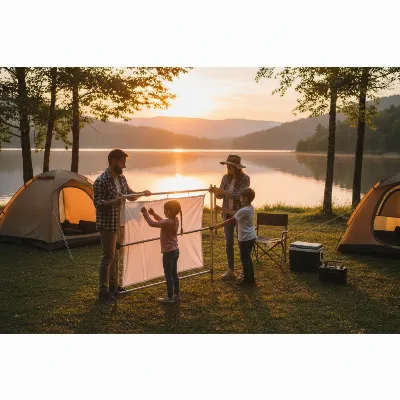 Family setting up a portable foldable frame projector screen at a lakeside campsite during sunset, working together
Key Factors When Choosing a Portable Projector Screen for Camping (Buying Guide)
Selecting the ideal portable projector screen for your camping adventures goes beyond just picking a type. Several critical factors influence performance, durability, and overall enjoyment.
Size and Aspect Ratio
The size of your screen should correspond to your viewing space and audience. For most camping scenarios, screens ranging from 80 to 120 inches diagonally are popular. A 100-inch to 120-inch screen often provides a cinematic feel without being overly cumbersome for transport or setup.
- Determining appropriate screen size: Consider the “1.5x rule”: your closest seating distance should be approximately 1.5 times the screen’s width. For example, if viewers will be 12 feet away, choose a screen around 8 feet wide (roughly 110-inch diagonal in 16:9). Balance this with the physical space available at your campsite.
- Choosing aspect ratio: The 16:9 aspect ratio is standard for most movies, TV shows, and video games, making it the most versatile choice for camping entertainment. A 4:3 ratio is more suited for presentations but less common for recreational outdoor viewing.
Screen Material
The material of your projector screen significantly impacts image quality, durability, and weather resistance.
- Common materials:
- Matte White: The most versatile material, offering excellent color reproduction and wide viewing angles (gain 1.0-1.1). Great for environments with controlled light (i.e., dark nights).
- PVC (Polyvinyl Chloride): Often used for its smooth texture, durability, and weather resistance against wind, rain, and UV rays. It’s a popular choice for outdoor screens due to its robust nature.
- Polyester: Offers good color accuracy and contrast, less prone to wrinkles than some vinyls, and can be coated for weather resistance.
- High Gain Materials (e.g., Glass Beaded, gain >1.1): Boosts brightness, which can be helpful in ambient light, but often narrows the viewing angle and can cause “hotspotting” (uneven brightness). For camping, a gain of 1.1-1.3 is generally optimal for balancing brightness and viewing angle after dusk.
- Impact of material: Look for wrinkle-free materials that are easy to clean. Weather-resistant and waterproof properties are crucial for outdoor use, ensuring the screen can withstand rain, humidity, and UV exposure without fading or developing mold.
Contrast and Brightness
While your projector’s lumen output is the primary factor for brightness, the screen material plays a vital role in optimizing the projected image.
- How screen material affects image quality: Screen gain (reflectivity) impacts how bright and vibrant the image appears. A screen with a gain of 1.1-1.3 is often recommended for outdoor use to enhance brightness without sacrificing too much viewing angle, especially in environments where some ambient light might be present before complete darkness.
- Selecting a screen: Matte white materials provide a neutral and uniform reflection, preserving color accuracy. Some screens feature special coatings to reject ambient light (ALR), though these are less common and more expensive for portable camping setups.
Viewing Angle
A wide viewing angle ensures that everyone gathered around the screen, regardless of their position, can enjoy a clear and consistent image without significant drop-off in brightness or color.
- Importance for group camping: With friends and family often scattered around a campfire or sitting on various camping chairs, a wide viewing angle (typically 160 degrees or more) is highly desirable to prevent anyone from seeing a dim or distorted picture.
- How to choose: Matte white and many PVC/polyester screens generally offer good wide viewing angles. High-gain screens can sometimes narrow this, so consider your typical audience setup.
Ambient Light Rejection
Ambient Light Rejecting (ALR) screens are designed to minimize the impact of surrounding light sources on the projected image, leading to better contrast and color saturation.
- How ALR screens work: These screens have a specialized optical layer that selectively reflects light from the projector while absorbing light coming from other angles.
- Benefits for outdoor use: While true ALR screens are more common in home theaters, some outdoor screen materials offer a degree of ambient light handling. This can be beneficial if you plan to start your movie night just before full darkness or if there are unavoidable light sources at your campsite. However, for most camping scenarios, waiting for complete darkness remains the best way to achieve optimal image quality.
Durability and Weather Resistance
The outdoors can be unpredictable, making durability and weather resistance paramount for any camping gear.
- Importance for camping: Your screen should be able to withstand light winds, resist mildew and mold in humid conditions, and be UV-protected to prevent fading from sun exposure. The frame should also be robust enough to handle repeated assembly and disassembly.
- What to look for: Seek out screens made from thick PVC or coated polyester. Check for rust-resistant aluminum frames and sturdy connecting hardware. Screens that come with ground stakes, tethers, or sandbags are essential for stability in windy conditions. The Elite Screens Pop-Up Cinema is known for its durable construction and ease of setup.
Portability and Ease of Setup
For camping, convenience is key. You don’t want to spend precious outdoor time struggling with complex equipment.
- Weight and packed size: Choose a screen that is lightweight and folds or deflates into a compact carrying case that fits easily into your vehicle or camping gear.
- Assembly time: Look for “tool-free assembly” and systems that promise quick setup, ideally under 5-10 minutes. Inflatable screens are very fast, while foldable frames can also be quick once you’re familiar with them.
- Anchoring mechanisms: Ensure the screen comes with adequate anchoring accessories like stakes, guide ropes, or fillable sandbags to keep it secure in light breezes.
Brand and Price
While it’s tempting to opt for the cheapest option, investing in a reputable brand often pays off in terms of quality, durability, and customer support.
- Reputable brands: Brands like Elite Screens, HOIN, VIVO, and XGIMI are frequently mentioned for their portable outdoor projector screens.
- Balancing cost and quality: Prices for portable camping screens can vary widely. Determine your budget, but prioritize features like material quality, stability, and ease of setup, as these directly impact your outdoor viewing experience. A screen that lasts for many camping seasons will be a better value in the long run.
Conclusion
Creating a memorable outdoor cinema experience while camping is a fantastic way to enjoy nature and entertainment simultaneously. From the robust stability of a foldable frame screen to the impressive size and speed of an inflatable model, or the ultimate portability of a tripod screen, there’s a perfect option for every adventurer. By carefully considering factors like screen size, material, viewing angle, durability, and ease of setup, you can select a projector screen that enhances your outdoor excursions for years to come. So, pack your snacks, fire up the projector, and get ready for countless nights of cinematic magic under the open sky.
What cinematic adventure will you embark on during your next camping trip?
Frequently Asked Questions
What screen size is best for camping?
For most camping setups, a screen size between 80 to 120 inches diagonally is ideal. This range offers a great balance between an immersive viewing experience and practical portability, ensuring it’s not too large to transport or set up in varying outdoor spaces while still providing a clear, engaging picture for a small group.
Can projector screens get wet?
Many portable projector screens designed for outdoor use, especially those made from PVC or coated polyester, are designed to be weather-resistant and can withstand moisture. However, it’s crucial to check the manufacturer’s specifications. Always ensure the screen is completely dry before packing it away to prevent mildew and extend its lifespan.
How do I stabilize a projector screen in the wind?
To stabilize a portable projector screen in windy conditions, most models come with ground stakes, guide ropes, or fillable sandbags. Anchoring the screen securely into the ground or weighing down its base significantly reduces the risk of it being blown over. Inflatable screens, with their large, air-filled bases, also offer inherent stability when properly anchored.
What screen material is best for outdoor use?
For outdoor use, materials like high-quality PVC or coated polyester are highly recommended. These materials are chosen for their durability, weather resistance (UV protection, mildew resistance), and ability to provide a flat, wrinkle-free projection surface. A gain of 1.1-1.3 for matte white or similar surfaces is often optimal to balance brightness and viewing angle.
Are inflatable projector screens good for camping?
Yes, inflatable projector screens are an excellent choice for camping, particularly if you desire a very large screen with minimal setup effort. They are lightweight when deflated, pack compactly, and can be set up in minutes using a pump. However, be mindful of potential punctures and the need for a power source for inflation.
